
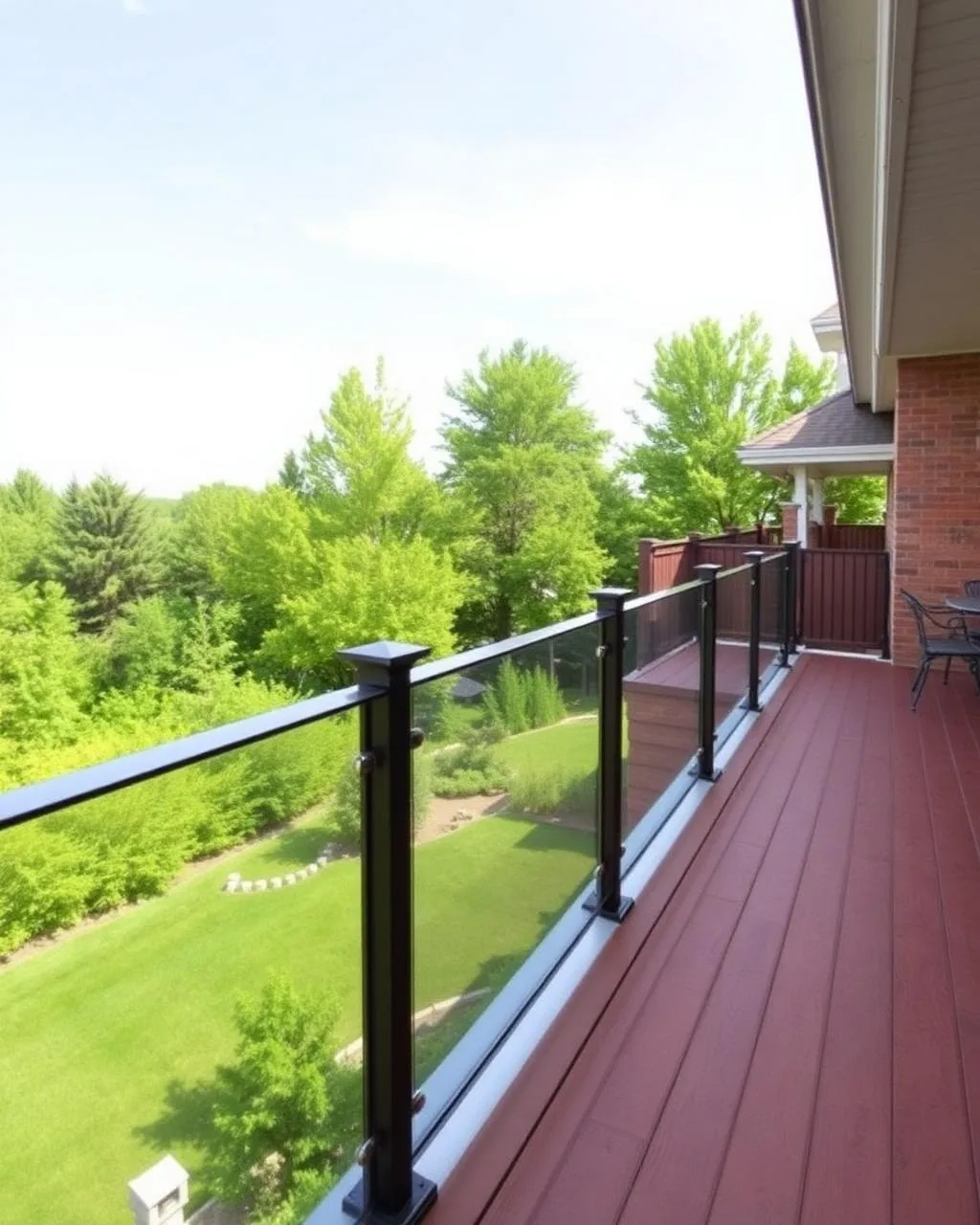
Glass railings are one of the lowest-maintenance exterior products you can install on a Greater Toronto Area home — but they aren't no-maintenance. Ontario's climate puts a railing through more cycles in a year than most products see in a decade: hot humid summers, salt-loaded lake breezes off the Scarborough bluffs, freeze-thaw cycles every few weeks all winter, and road-salt overspray from December through April.
If you spend an hour a season on the routine below, your glass railing will look the day you installed it ten and twenty years from now. Skip it, and you'll be replacing hardware in five.
Tip 1: Rinse Before You Wipe — Always
The single fastest way to ruin a glass panel is to drag a dry cloth across a dirty surface. GTA rain, lake-front breezes, and ambient road dust all carry fine grit that acts like sandpaper the moment it gets pressed into the glass. Always rinse the panel with plain water from a hose first — top to bottom, both sides. Let it sit for 30 seconds so any embedded grit lifts off. Then clean.
For homeowners in lake-adjacent neighbourhoods like the Scarborough Bluffs, Oakville waterfront, or the Burlington pier district, a rinse-only treatment every two weeks during the summer is enough to prevent salt-spray buildup from etching the glass surface.
Tip 2: Use the Right Cleaner
Skip the all-purpose blue spray. A dedicated streak-free glass cleaner and a clean microfibre cloth will outperform anything else on the shelf. For hard-water spots — common across the GTA wherever sprinkler overspray hits the railing — a 50/50 mix of distilled white vinegar and water works perfectly and won't harm any standard hardware finish.
What to avoid: ammonia-heavy products (they fog low-iron glass over time), abrasive scouring pads (they scratch tempered glass surface coatings), and any product with hydrofluoric acid or bifluoride (they etch glass permanently).
Tip 3: Inspect the Hardware Every Spring
Once a year, walk the railing and check every base shoe, standoff pin, or spigot for movement. Any visible fastener should still be finger-tight. Make a note of anything that wiggles for a follow-up service call. After the first Ontario winter, a torque check is normal — temperature swings move things microscopically and a 5-minute re-check is good preventive practice.
On spigot and standoff systems, also inspect the rubber gaskets where the glass meets the metal. UV and ozone slowly degrade gasket rubber over 8–10 years; replacing them is a flat-rate job and prevents glass-to-metal contact that can chip a panel edge.
Tip 4: Manage Snow and Ice Like a Pro
Ontario winters do more damage to the wrong railing in three months than the rest of the year combined. Three rules.
Brush Snow, Don't Chip Ice
If your system has an aluminum or stainless top rail, brush snow off with a soft plastic deck brush. Never use a metal shovel or scraper — even on the glass. The risk isn't cracking the panel, it's scoring the surface. Once the surface is scored, it holds dirt forever.
Keep Salt and De-Icer Off the Hardware
Salt and calcium chloride de-icer should never touch glass railing hardware. Both will accelerate corrosion of stainless and powder-coated finishes. If your front-entry railing is in the path of salt overspray from a driveway or sidewalk, rinse the hardware with plain water during winter thaws and again as soon as spring weather arrives.
Watch for Ice Sheets on the Top Rail
On long top-rail runs, ice can form a sheet that, when it slides, carries hardware fasteners with it. Brushing snow off after every storm prevents the sheet from forming in the first place.
Tip 5: Re-Seal Wet-Glaze Joints Every 5–7 Years
Frameless base-shoe systems with a wet-glaze top finish use a continuous silicone bead between the glass and the channel. UV and freeze-thaw slowly cure the silicone hard, and after about five to seven years it loses its flex. Once the bead loses flex, water can wick into the channel — and water inside an aluminum channel during an Ontario freeze-thaw cycle is what turns a 25-year railing into a 12-year railing.
Re-sealing is a flat-rate service, no glass removal required, and it adds another 5–7 years to the wet-glaze life. Glass Railing Experts offers it across the GTA — call 647-474-4751 to book a spring re-seal once your railing hits the 5-year mark.
Bonus Tip: Schedule a Pro Inspection at the 10-Year Mark
Most quality glass railings last 25 to 40 years with basic maintenance. A professional inspection at the 10-year mark catches the small issues — a loosening fastener, a degraded gasket, a marginal silicone bead — before they become expensive ones. We offer this as a flat-rate service in Toronto, Mississauga, Vaughan, and every other GTA city we serve.
Need Service or a New Install?
Whether you need a maintenance call on an existing railing or a free quote on a new install, call Glass Railing Experts at 647-474-4751. We cover all 20 GTA cities from our shop at 130 Lepage Ct, North York — and every quote is free, fixed-price, and good for 90 days.
Ready to start your project?
Get a free, fixed-price quote across the GTA.